Every marketer knows there are certain selling seasons that cannot be ignored -- Halloween, Black Friday, Cyber Monday, Christmas, Hanukah, Valentine's Day. However, they may not be aware that today's digital marketing should go beyond a one-size-fits-all approach, regardless of consumers' natural inclination to shop more at certain times of year. Marketers need to start going above and beyond offering deep discounts or clinging to catchy marketing messages.
With consumers spending more time and money online, marketers must prepare their digital marketing strategy to proactively target today's savvy shopper -- or risk losing prime revenue to the competition. This year, Channel Advisor's 2010 Consumer Shopping Habits survey found that more than 58 percent of consumers are very likely to purchase gifts online, as opposed to the 41 percent who choose to shop at brick-and-mortar stores.
According to comScore, consumers spent $29.1 billion online alone during the 2009 holiday shopping season, and eMarketer predicts that e-commerce spending will reach $51.4 billion by the fourth quarter of 2010. With numbers like these, the online opportunity -- both during holidays and off-season -- has nowhere to go but up. That said, driving online retail traffic is only the beginning: Marketers must step up their game and begin to truly engage customers by personalizing and tailoring the seasonal shopping experience.
What works
Improving web traffic via analytics and SEO methods has been digital marketers' focus for so long that most have pretty much mastered it. And while landing page optimization strategies are often given careful attention, content and design decisions are typically based on subjectivity. It's time to stop guessing and concentrate on what happens after visitors arrive. By neglecting the real tactics that convert browsers into buyers, marketers continue to miss out on tremendous revenue growth.
As consumers evolve, marketers attempt to improve website complexity and messaging -keeping it fresh and up-to-date. But sites that do not employ methods to truly remain dynamic are not equipped to optimally perform during seasonal holiday spending surges. Changing your content and adding new product offers isn't enough to drive double-digit revenue growth...
You'll need to go a few steps further:
1. Cater to your customers' mood. Create a seasonal site design to demonstrate your brand's holiday spirit. Display items most likely to sell during a particular season on your most popular website pages.
2.Target and recommend. Prominently display product offers, discounts and promotions targeted to match customers' needs. Make sure everything they may want to buy is easily located in a single virtual aisle.
3.Make it easy to buy. Thoroughly A/B test and improve important forms. If the registration, login, or checkout processes are too cumbersome, shoppers will simply give up at the point-of-purchase.
4.Use live multivariate testing and iterative tweaking to drive higher conversion rates. Subtle changes such as font size, color, and copy can have a huge impact on revenues. Test different variations to see what yields the best results based on your live visitors' interactions.
5.Monitor and learn from customer behavior. A one-size-fits-all website doesn't deliver the best brand experience. Improve behavioral targeting to deliver a better online experience by offering page layouts, product recommendations, sequences, content, and offers that have been dynamically selected based on users' demonstrated preferences.
6.Make navigation effortless. Shoppers won't fill their shopping carts or click anywhere near the checkout line if they are bounced around a poorly designed website. Go back to the basics: Make it easy for customers to find their way around by including a search facility; make the checkout page prominent; and avoid zeroing out filled-in forms every time they change pages.
7.Make it personal. Go beyond the standard "people who bought this, also bought this" suggestions by using website personalization. Product suggestions and wish list options that are relevant based on the individual shopper's site activity will vastly improve revenues.
Make every season a success
All the time and money spent on search, SEO, advertising, and landing page optimization will be wasted if true optimization strategies aren't put into place. Solutions such as multivariate testing, website personalization, and behavioral targeting make marketers' job easier every day -- they also automatically improve the digital experience with fluctuations and changes in seasonal spending and customers' shopping moods. Ensure every seasonal shopping experience with your website is a happy one, for each and every individual user, and never miss your revenue mark again.
Showing posts with label online advertising. Show all posts
Showing posts with label online advertising. Show all posts
Thursday, December 16, 2010
Thursday, April 22, 2010
2010 Search Engine Optimization
Anyone with half a decent website gets bombarded with phone calls and e-mails everyday from people claiming that they can get you to the top of Google. The notion that someone can make that claim without understanding your business thoroughly, your target clients, and the competition you face to reach those clients is completely baseless. Choosing the right partner for Search Engine Optimization work can be very tricky. Regardless of who you decide to work with, do your homework before making a decision.
Discovery and what you should expect
The first step to creating a successful search engine optimization strategy is to understand the business that wants to be found in the search engines. Through discussions with you or your marketing team, the chosen agency can develop a thorough list of keywords and phrases which describe the products and services offered by your company. From this list, the agency will then expand it to include keywords and phrases which will ensure that your business is found when customers are searching for your competitors. The next logical step is then fine tune the list by reducing the amount of keywords and phrases, by eliminating those that are too competitive for the search engine optimization budget which has been allocated to the project. It is also important to include keywords and phrases which your customers will search for, and not necessarily the ones you might use to describe your own business.
Setting the Budget
Most businesses that are shopping for a search engine optimization partner get easily frustrated when trying to determine the expected cost of the project. This is mostly because you cannot pinpoint an exact cost for an exact result as you normally can with paid online advertising. As explained above, the agency should work closely with you to determine a list of keywords and phrases for which you can achieve measurable results given the budget allocated. In other words, it does not make sense to promise you a top spot in Google for a very competitive keyword if your budget does not allow your company to achieve those results. If you have a set budget in mind, you should be given a realistic expectations level about the results you can expect with that budget. If you have a certain goal in mind in terms of search engine rankings, your agency can tell you what budget will be required to achieve those goals.
A tried and proven Process
There are many facets to search engine optimization and it is too cumbersome to get into all of them here, but the essential elements are to ensure that your website is built in a way that is friendly to the search engines, modifying your website content to attract the consumers that you are interested in attracting, and building links from other websites to yours. Achieving higher organic rankings will have a tremendous impact on your business as a whole, and should be measured accordingly.
Timeline
If anybody has told you that search engine optimization can take months to show results, they were right. Unfortunately this has allowed many scam artists to make false promises and charge their clients for months without doing anything until the client realizes that there are no results. This is another reason why it is important to choose your search engine optimization partner carefully, and work with an established reputable firm rather than someone who calls you randomly. It is also important to understand that Search Engine Optimization is not something that you purchase… it is an ongoing process. While you usually can expect to see results within 3 to 4 months, it is also common to see companies drop off the search engines because they decided that they were no longer interested in investing into SEO since they had already achieved the high rankings they had hoped for.
Google Analytics and Webmaster Tools
With the implementation of specialty SEO plug-ins for the websites we build, you will have access to a comprehensive set of reports from Google Analytics. These analytics will give you insight on how your website is performing, and where people are looking when visiting your site.
Ongoing Support
Don’t have the time to update your site? Busy doing the things that company owners have to do to be successful in managing and building a small business? Some agencies will update your site and keep your blog, news and/or press sections full of current and relevant information about your company. Finding the right agency to facilitate your search engine optimization and related interactive needs, will allow you to concentrate on your clients.
Ask for their Unconditional Guarantee
Make sure that your chosen agency can assure you that they only use the most current technology and that you always will be managed on the most cost efficient, most user-friendly, and effective technology platform for your company.
Discovery and what you should expect
The first step to creating a successful search engine optimization strategy is to understand the business that wants to be found in the search engines. Through discussions with you or your marketing team, the chosen agency can develop a thorough list of keywords and phrases which describe the products and services offered by your company. From this list, the agency will then expand it to include keywords and phrases which will ensure that your business is found when customers are searching for your competitors. The next logical step is then fine tune the list by reducing the amount of keywords and phrases, by eliminating those that are too competitive for the search engine optimization budget which has been allocated to the project. It is also important to include keywords and phrases which your customers will search for, and not necessarily the ones you might use to describe your own business.
Setting the Budget
Most businesses that are shopping for a search engine optimization partner get easily frustrated when trying to determine the expected cost of the project. This is mostly because you cannot pinpoint an exact cost for an exact result as you normally can with paid online advertising. As explained above, the agency should work closely with you to determine a list of keywords and phrases for which you can achieve measurable results given the budget allocated. In other words, it does not make sense to promise you a top spot in Google for a very competitive keyword if your budget does not allow your company to achieve those results. If you have a set budget in mind, you should be given a realistic expectations level about the results you can expect with that budget. If you have a certain goal in mind in terms of search engine rankings, your agency can tell you what budget will be required to achieve those goals.
A tried and proven Process
There are many facets to search engine optimization and it is too cumbersome to get into all of them here, but the essential elements are to ensure that your website is built in a way that is friendly to the search engines, modifying your website content to attract the consumers that you are interested in attracting, and building links from other websites to yours. Achieving higher organic rankings will have a tremendous impact on your business as a whole, and should be measured accordingly.
Timeline
If anybody has told you that search engine optimization can take months to show results, they were right. Unfortunately this has allowed many scam artists to make false promises and charge their clients for months without doing anything until the client realizes that there are no results. This is another reason why it is important to choose your search engine optimization partner carefully, and work with an established reputable firm rather than someone who calls you randomly. It is also important to understand that Search Engine Optimization is not something that you purchase… it is an ongoing process. While you usually can expect to see results within 3 to 4 months, it is also common to see companies drop off the search engines because they decided that they were no longer interested in investing into SEO since they had already achieved the high rankings they had hoped for.
Google Analytics and Webmaster Tools
With the implementation of specialty SEO plug-ins for the websites we build, you will have access to a comprehensive set of reports from Google Analytics. These analytics will give you insight on how your website is performing, and where people are looking when visiting your site.
Ongoing Support
Don’t have the time to update your site? Busy doing the things that company owners have to do to be successful in managing and building a small business? Some agencies will update your site and keep your blog, news and/or press sections full of current and relevant information about your company. Finding the right agency to facilitate your search engine optimization and related interactive needs, will allow you to concentrate on your clients.
Ask for their Unconditional Guarantee
Make sure that your chosen agency can assure you that they only use the most current technology and that you always will be managed on the most cost efficient, most user-friendly, and effective technology platform for your company.
Tuesday, March 09, 2010
Europe: New Decade Heralds The Age Of Digital Mobility
Europeans are more mobile and engaged with online than ever
Key European Findings
· Europeans are spending more time on 'internet-on-the-move’ (6.4 hours a week) compared to reading newspapers (4.8 hours) or magazines (4.1 hours)
· A rise in laptop ownership is driving greater media convergence – 36% of Europeans use the internet whilst watching TV
· There are now 121 million wireless broadband users in Europe allowing a greater mobility for internet users
· 71 million Europeans use the internet on their mobile each week – for an average of almost one hour every day
· Eastern European markets demonstrate opportunity for marketers to engage users via mobile internet
The European Interactive Advertising Association (EIAA) reveals the findings of new research that shows digital mobility making its way into the mainstream. Technological innovation coupled with a diverse range of access points for consumers is driving deeper usage online, presenting marketers with a vastly mobile pan-European audience to target and engage with in 2010 and beyond.
The EIAA’s Mediascope Europe study across 15 European markets highlights how consumers are extending the ways in which they enjoy and engage with the internet and its growing influence on everyday lives. With a majority of people now aware they can use the internet via their mobile phone (48% vs. 47%), and a growth in wireless broadband and laptop use, the findings demonstrate how the increased diversity of internet-enabled devices is allowing consumers to go online at any time of day and in more locations than ever before.
Increase in internet-on-the-move
Overall, 71 million Europeans browse the mobile internet in a typical week and, with almost an hour a day actively spent going online via their mobile (6.4 hours per week), 'internet-on-the-move’ is proving a more frequent pastime than reading newspapers (4.8 hours) or magazines (4.1 hours).
It is the younger generation of early adopters that is largely driving this increase with almost a quarter (24%) of 16-24 year olds and 21% of 25-34 year olds already using the mobile internet, spending 7.2 and 6.6 hours on it respectively each week. This trend of increased consumer reach and time spent online looks set to continue with improving internet coverage, speeds and services. Marketers would therefore be well advised to recognise how consumers are increasingly engaging with the internet, at more times throughout their day and across a myriad of interactive touch points, and ultimately use this insight to develop effective multi-media marketing strategies.
The internet as an entertainer and enabler
The internet continues to prove a popular source of entertainment with one quarter of Europeans (25%) gaming or listening to the radio online (25%), and one third watching films, TV or video clips online (32%) at least once a month. With over one quarter (29%) of Europeans following brands more as a result of the internet, the medium is being used for fun and for function signifying that users have high levels of both emotional and rational connection with the medium. Amongst those with an internet enabled phone, half (49%) claim to receive video clips, websites or images on their mobile and four in five (80%) say that they pass on the content they receive. This suggests that those online via their mobile are both technologically sophisticated and deeply engaged - highlighting a prime opportunity for marketers to build brand awareness and peer recommendations.
Additionally, 'Word of Web[1]’ continues to play a central role in communications with almost three quarters (71%) of European internet users admitting that they stay in touch with friends and relatives more as a result of the internet. Again, mobile seems to be a big driver with almost half (48%[2]) of Europeans using their internet enabled phones for more than verbal conversation. 16% state they communicate using social media via their mobile, with 16% also using mobile instant messenger. Advertisers can therefore benefit from the growing consumer appitite for constant updates and entertainment on the go and use this insight to plan for multi-media campaigns that engage with consumers across a number of platforms.
Converging media experiences
Media convergence is on the rise with the research revealing that one third (36%) of European use the internet whilst watching TV. With recent technological advancements such as the iPad, and given almost half (46%) of European households already own at least one laptop and 121 million Europeans (52%) now use wireless broadband, increased mobility and convergence seems inevitable. Marketers should no longer look at media in isolation but rather embrace the media-meshing trend and the wealth and diversity of advertising opportunity it affords.
Extending scope: changing the status quo
This year the Mediascope Europe study has been extended to incorporate a further five European markets in addition to the original ten. The research now includes Poland, Portugal, Russia, Switzerland and Turkey to capture the different ways in which consumer media habits and behaviours are developing across Europe.
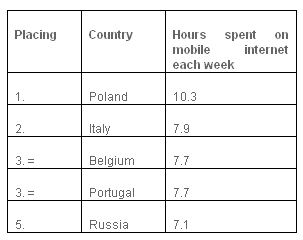
While these markets all display very different characteristics and are at varying stages of internet development, one trend that stands out is the speed of mobile internet growth. This is particularly apparent amongst the larger Eastern European countries, all of which show no signs of the time-lag observed in larger Western countries when dial-up internet and broadband connections were first adopted. Poland tops the chart of markets that spend the most time on mobile internet, with Russia also appearing in the top five. Interestingly, there are more mobile internet users in Turkey compared to those that access internet via their PC (21% vs. 20%) demonstrating that consumers will engage with new platforms if it makes the internet more accessible for their everyday lives.
These 'newer’ markets such as Russia, Turkey, Poland and Portugal are regarded as rising stars, with a rapid increase in weekly internet use expected in coming years. With an average growth in European internet use of 11% every 2 years, we can predict how internet penetration in these markets might grow in coming years - a useful indication for media planners as they as they increase the scope of their pan-European campaigns:
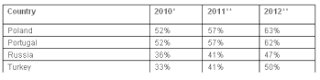
* Actual % internet use taken from EIAA Mediascope Europe 2010
** EIAA predictions (created using findings from Mediascope Europe 2004-2010 and externally sourced local market data)
Alison Fennah, Executive Director of the EIAA said: “Better devices and connectivity as well as enhanced consumer motivation all started coming together in 2009 to improve and extend the overall online experience. As a result, the internet is now being consumed across PC, laptop, mobile and gaming devices, providing 24-7 access to digital information and entertainment. This presents a compelling case for brands to explore and incorporate a growing number of complementary interactive platforms into the marketing mix.
“Indeed, new age patterns of media consumption indicate that marketers should be looking to develop multi-platform strategies that reach and connect with consumers more effectively and increase ROI. This is opposed to making media decisions based on an 'either or’ basis if they want to reach all demographics.”
Michael Kleindl, Chairman of the EIAA and Managing Partner of Valkiria Network said: “Technological innovation coupled with consumers’ continued desire to merge their media presents a huge opportunity for advertisers as we move into 2010. It is important for brands to adapt to this shift in internet mobility and use this insight to shape their marketing strategies.”
[1] The developing trend of 'word of mouth’ to 'word of web’ or communicating online
[2] This is an aggregate of: communicating via social networking sites and sending / receiving emails and instant messenger
Key European Findings
· Europeans are spending more time on 'internet-on-the-move’ (6.4 hours a week) compared to reading newspapers (4.8 hours) or magazines (4.1 hours)
· A rise in laptop ownership is driving greater media convergence – 36% of Europeans use the internet whilst watching TV
· There are now 121 million wireless broadband users in Europe allowing a greater mobility for internet users
· 71 million Europeans use the internet on their mobile each week – for an average of almost one hour every day
· Eastern European markets demonstrate opportunity for marketers to engage users via mobile internet
The European Interactive Advertising Association (EIAA) reveals the findings of new research that shows digital mobility making its way into the mainstream. Technological innovation coupled with a diverse range of access points for consumers is driving deeper usage online, presenting marketers with a vastly mobile pan-European audience to target and engage with in 2010 and beyond.
The EIAA’s Mediascope Europe study across 15 European markets highlights how consumers are extending the ways in which they enjoy and engage with the internet and its growing influence on everyday lives. With a majority of people now aware they can use the internet via their mobile phone (48% vs. 47%), and a growth in wireless broadband and laptop use, the findings demonstrate how the increased diversity of internet-enabled devices is allowing consumers to go online at any time of day and in more locations than ever before.
Increase in internet-on-the-move
Overall, 71 million Europeans browse the mobile internet in a typical week and, with almost an hour a day actively spent going online via their mobile (6.4 hours per week), 'internet-on-the-move’ is proving a more frequent pastime than reading newspapers (4.8 hours) or magazines (4.1 hours).
It is the younger generation of early adopters that is largely driving this increase with almost a quarter (24%) of 16-24 year olds and 21% of 25-34 year olds already using the mobile internet, spending 7.2 and 6.6 hours on it respectively each week. This trend of increased consumer reach and time spent online looks set to continue with improving internet coverage, speeds and services. Marketers would therefore be well advised to recognise how consumers are increasingly engaging with the internet, at more times throughout their day and across a myriad of interactive touch points, and ultimately use this insight to develop effective multi-media marketing strategies.
The internet as an entertainer and enabler
The internet continues to prove a popular source of entertainment with one quarter of Europeans (25%) gaming or listening to the radio online (25%), and one third watching films, TV or video clips online (32%) at least once a month. With over one quarter (29%) of Europeans following brands more as a result of the internet, the medium is being used for fun and for function signifying that users have high levels of both emotional and rational connection with the medium. Amongst those with an internet enabled phone, half (49%) claim to receive video clips, websites or images on their mobile and four in five (80%) say that they pass on the content they receive. This suggests that those online via their mobile are both technologically sophisticated and deeply engaged - highlighting a prime opportunity for marketers to build brand awareness and peer recommendations.
Additionally, 'Word of Web[1]’ continues to play a central role in communications with almost three quarters (71%) of European internet users admitting that they stay in touch with friends and relatives more as a result of the internet. Again, mobile seems to be a big driver with almost half (48%[2]) of Europeans using their internet enabled phones for more than verbal conversation. 16% state they communicate using social media via their mobile, with 16% also using mobile instant messenger. Advertisers can therefore benefit from the growing consumer appitite for constant updates and entertainment on the go and use this insight to plan for multi-media campaigns that engage with consumers across a number of platforms.
Converging media experiences
Media convergence is on the rise with the research revealing that one third (36%) of European use the internet whilst watching TV. With recent technological advancements such as the iPad, and given almost half (46%) of European households already own at least one laptop and 121 million Europeans (52%) now use wireless broadband, increased mobility and convergence seems inevitable. Marketers should no longer look at media in isolation but rather embrace the media-meshing trend and the wealth and diversity of advertising opportunity it affords.
Extending scope: changing the status quo
This year the Mediascope Europe study has been extended to incorporate a further five European markets in addition to the original ten. The research now includes Poland, Portugal, Russia, Switzerland and Turkey to capture the different ways in which consumer media habits and behaviours are developing across Europe.
While these markets all display very different characteristics and are at varying stages of internet development, one trend that stands out is the speed of mobile internet growth. This is particularly apparent amongst the larger Eastern European countries, all of which show no signs of the time-lag observed in larger Western countries when dial-up internet and broadband connections were first adopted. Poland tops the chart of markets that spend the most time on mobile internet, with Russia also appearing in the top five. Interestingly, there are more mobile internet users in Turkey compared to those that access internet via their PC (21% vs. 20%) demonstrating that consumers will engage with new platforms if it makes the internet more accessible for their everyday lives.

These 'newer’ markets such as Russia, Turkey, Poland and Portugal are regarded as rising stars, with a rapid increase in weekly internet use expected in coming years. With an average growth in European internet use of 11% every 2 years, we can predict how internet penetration in these markets might grow in coming years - a useful indication for media planners as they as they increase the scope of their pan-European campaigns:

* Actual % internet use taken from EIAA Mediascope Europe 2010
** EIAA predictions (created using findings from Mediascope Europe 2004-2010 and externally sourced local market data)
Alison Fennah, Executive Director of the EIAA said: “Better devices and connectivity as well as enhanced consumer motivation all started coming together in 2009 to improve and extend the overall online experience. As a result, the internet is now being consumed across PC, laptop, mobile and gaming devices, providing 24-7 access to digital information and entertainment. This presents a compelling case for brands to explore and incorporate a growing number of complementary interactive platforms into the marketing mix.
“Indeed, new age patterns of media consumption indicate that marketers should be looking to develop multi-platform strategies that reach and connect with consumers more effectively and increase ROI. This is opposed to making media decisions based on an 'either or’ basis if they want to reach all demographics.”
Michael Kleindl, Chairman of the EIAA and Managing Partner of Valkiria Network said: “Technological innovation coupled with consumers’ continued desire to merge their media presents a huge opportunity for advertisers as we move into 2010. It is important for brands to adapt to this shift in internet mobility and use this insight to shape their marketing strategies.”
[1] The developing trend of 'word of mouth’ to 'word of web’ or communicating online
[2] This is an aggregate of: communicating via social networking sites and sending / receiving emails and instant messenger
Tuesday, January 19, 2010
Online Newspaper Advertising - Latin America
Online newspapers are the essential link for people to stay connected to information, news and their home countries.
When they read the news directly from online newspapers such as La Prensa from Panama or La Republica from Costa Rica, they are receiving un-biased news and information directly from their country. Readers review their local news covering subjects from politics to the latest gossip from their countries' entertainment. Now the technological enhancements of the internet makes reading online newspapers easier than ever!
I stumbled upon an article by Mort Goldstrom about the reasons why to advertise in online newspapers. I think this very much applies to Latin America and reinforces why it is so important for advertisers to include this in their online marketing mix. I hope sharing this with you increases your knowledge and helps you understand more in depth how the online newspaper opportunities can really work for your clients.
10 Reasons to Advertise on a Newspaper Website
Frequency- The online newspaper Web site user spends more than twice as many hours online than the general user. Online newspaper users are three times as likely as general 'Net users to be online during the workday when out of reach of other media - 8-11 a.m. is a new "primetime" for media consumption (Source: "Power Users," 2006, MORI Research)
Credibility- Branded content brings a higher quality audience. A study from the Online Publishers Association (OPA) showed that OPA audiences were more likely to buy products and services in a number of key categories, including automotive, entertainment, financial, home, travel and business to business.
Targeted- If you want to focus on a particular backyard, advertising in an online newspaper is more personal and more relevant because it is local. Newspapers also publish a plethora of niche sites (youth, women, movie fans, Hispanics, are illustrative) for virtually any demographic advertisers could possibly hope to reach. - "Newspapers know more than ever about their web audience because of online registration programs and audience segmentation software"]
Purchasing Power- Eighty-nine percent of newspaper Web site users purchase online compared with 56 percent of general users. Forty percent of online newspaper users have incomes higher than $75,000; 69 percent own their homes. Eighteen percent of online newspaper users have spent more than $2,000 online in the last six months.
Content- Excluding e-mail the most popular online activities and content categories include national and local news, sports, financial information and entertainment news and things to do. [Shopping, cited in the original, is lower on the list.] Fifty-four percent of general Internet users visit online newspapers for local news, compared with 40 percent for the local TV station Web site and 20 percent for the local radio station site. ["Power Users," 2006, MORI Research]
Advertisers Believe in Newspaper Sites- Online newspapers have enjoyed eleven consecutive quarters of double digit increases for advertising since NAA started reporting online ad spending in 2004.
High Profile- Online newspapers generate very large gains in Online Ad Awareness among C-level and other higher management job holders: C-level managers showed a 23 percent increase in Aided Brand Awareness, VP/director-level managers showed a 38 percent increase and other management showed a 37 percent increase following their exposure to an ad campaign in online newspapers (across all industries.) When the brand metric shifts to Message Association, C-level execs showed the largest increase in lift after exposure to campaigns on online newspapers, at 88 percent. No management category showed less than a 51 percent increase. (Dynamic Logic's MarketNorms database, 2006)
Reinforcement- Fifty-six percent of online newspaper users also read the newspaper in the past five days, and repetition increases awareness.
Cutting Edge- Newspaper Web site users are more likely (by almost twenty percent to own some kind of portable electronic device. They are also more interested in receiving advertising and product offers through those devices. Forty percent of online newspaper users are aged 18 to 34. [Source: "Power Users," 2006, MORI Research]
Mix- A variety of recent studies have demonstrated the power of online, when included in a mix with traditional media, to elaborate the brand message. Newspaper, print, and online products combined have the highest penetration and most desirable audience of any other local medium.
When they read the news directly from online newspapers such as La Prensa from Panama or La Republica from Costa Rica, they are receiving un-biased news and information directly from their country. Readers review their local news covering subjects from politics to the latest gossip from their countries' entertainment. Now the technological enhancements of the internet makes reading online newspapers easier than ever!
I stumbled upon an article by Mort Goldstrom about the reasons why to advertise in online newspapers. I think this very much applies to Latin America and reinforces why it is so important for advertisers to include this in their online marketing mix. I hope sharing this with you increases your knowledge and helps you understand more in depth how the online newspaper opportunities can really work for your clients.
10 Reasons to Advertise on a Newspaper Website
Frequency- The online newspaper Web site user spends more than twice as many hours online than the general user. Online newspaper users are three times as likely as general 'Net users to be online during the workday when out of reach of other media - 8-11 a.m. is a new "primetime" for media consumption (Source: "Power Users," 2006, MORI Research)
Credibility- Branded content brings a higher quality audience. A study from the Online Publishers Association (OPA) showed that OPA audiences were more likely to buy products and services in a number of key categories, including automotive, entertainment, financial, home, travel and business to business.
Targeted- If you want to focus on a particular backyard, advertising in an online newspaper is more personal and more relevant because it is local. Newspapers also publish a plethora of niche sites (youth, women, movie fans, Hispanics, are illustrative) for virtually any demographic advertisers could possibly hope to reach. - "Newspapers know more than ever about their web audience because of online registration programs and audience segmentation software"]
Purchasing Power- Eighty-nine percent of newspaper Web site users purchase online compared with 56 percent of general users. Forty percent of online newspaper users have incomes higher than $75,000; 69 percent own their homes. Eighteen percent of online newspaper users have spent more than $2,000 online in the last six months.
Content- Excluding e-mail the most popular online activities and content categories include national and local news, sports, financial information and entertainment news and things to do. [Shopping, cited in the original, is lower on the list.] Fifty-four percent of general Internet users visit online newspapers for local news, compared with 40 percent for the local TV station Web site and 20 percent for the local radio station site. ["Power Users," 2006, MORI Research]
Advertisers Believe in Newspaper Sites- Online newspapers have enjoyed eleven consecutive quarters of double digit increases for advertising since NAA started reporting online ad spending in 2004.
High Profile- Online newspapers generate very large gains in Online Ad Awareness among C-level and other higher management job holders: C-level managers showed a 23 percent increase in Aided Brand Awareness, VP/director-level managers showed a 38 percent increase and other management showed a 37 percent increase following their exposure to an ad campaign in online newspapers (across all industries.) When the brand metric shifts to Message Association, C-level execs showed the largest increase in lift after exposure to campaigns on online newspapers, at 88 percent. No management category showed less than a 51 percent increase. (Dynamic Logic's MarketNorms database, 2006)
Reinforcement- Fifty-six percent of online newspaper users also read the newspaper in the past five days, and repetition increases awareness.
Cutting Edge- Newspaper Web site users are more likely (by almost twenty percent to own some kind of portable electronic device. They are also more interested in receiving advertising and product offers through those devices. Forty percent of online newspaper users are aged 18 to 34. [Source: "Power Users," 2006, MORI Research]
Mix- A variety of recent studies have demonstrated the power of online, when included in a mix with traditional media, to elaborate the brand message. Newspaper, print, and online products combined have the highest penetration and most desirable audience of any other local medium.
Tuesday, April 21, 2009
U.S. Hispanics Repesent 10% of the Online Market
True to its reputation as a "melting pot," the U.S. boasts an increasingly large Hispanic population -- the implications of which, when it comes to advertising, go far beyond a language barrier. A recent report from Pew Hispanic Center stated that U.S. Hispanics have represented more than half of U.S. population growth since 2000.
Marketers may have been tempted in the past to ignore this group -- or, at the least, did little to tailor messaging to it -- but it is no longer financially wise to do so. According to a 2008 comScore survey on U.S Hispanics online, 5 percent of U.S. born and 17 percent of foreign-born Hispanics said they pay more attention to online video ads than TV spots, and 17 percent and 26 percent, respectively, find them more engaging than TV ads. The same survey also states that 13 percent of U.S. born and 22 percent of foreign-born Hispanics said they are more likely to respond to ads targeted to Hispanics.
The comparison of TV and online advertising as it relates to response rates should be viewed in context of the language barrier. In the U.S., there are television networks such as Univision, which are broadcast in Spanish and include direct cultural relevance to Hispanic audiences. These types of channels are certainly not the only ones that Spanish-speaking audiences may view, but they are a specific destination on television where they know they can see programming in their language. Similarly, the internet is a much vaster marketplace, but those same types of destinations exist, even though Spanish-language sites are not the only ones viewed by Hispanic audiences.
As more ad dollars shift to this growing segment of the U.S. population, those destinations will become in-demand (i.e., expensive) online inventory for marketers. So how do you reach out to other cultures in an effective and cost-efficient way?
Behavioral targeting can help marketers reach across the cultural divide, helping to identify Hispanic online audiences, or any other ethnic group for that matter, and deliver messaging that is relevant to not only their language, but also their overall culture. It can also expand the inventory marketers use to reach Hispanic audiences.
Behavioral targeting is used to create Hispanic audience segments first based on users who have visited Spanish-language sites or any sites with Hispanic-relevant content. You can then create sub-segments based on not only ethnicity, culture, or language, but also interests and purchase intent behaviors observed on those or other sites. You can even identify "purchase influencers" among U.S. Hispanic populations, based on browsing and buying behaviors plus geographic location. You may then serve culturally relevant marketing messages to these segments when they travel to any other site online.
You will also find re-targeting useful, once you have begun to build these behavioral segments. As you serve ads to your Hispanic audiences and sub-segments, you can then re-target them across whichever network or sites you choose, with upsell, cross-sell, or discount offers. As a marketer, make sure you're making the most out of these types of programs by using bilingual creative, or messages in Spanish, with themes and designs that will resonate with a Hispanic audience.
Finally, ensure that you are integrating your marketing into these segments with your other media programs. With your search program, you can strengthen your segments by layering your behavioral data with your search data. Behavioral profiles that have been tagged as part of a Hispanic audience or sub-segment can be given a boost by search data including Spanish-language or Hispanic content keywords or search engines that have been set to Spanish.
Consumer education is a challenge no matter what language you're speaking or audience you're trying to reach. If you decide to embark on a Hispanic-focused BT campaign, ensure that your privacy policies are clearly communicated in both languages on your site, as well as any type of opt-out or opt-in functions you provide.
According to SMG Multicultural CEO Monica Gadsby, 19.5 million U.S. Hispanics are online, 70 percent of Hispanic women are online, and Hispanics make up 10 percent of all online users. This might be a significant portion of your potential customer pool, and reaching out to them can be just as easy as reaching out to any audience segments, with a few process and creative changes. Based on its ability to accurately segment audiences, behavioral targeting is by far the most efficient way to market to the Hispanic population. And remember, these same principles can be applied to any cultural group that you want to reach out to in the country.
Marketers may have been tempted in the past to ignore this group -- or, at the least, did little to tailor messaging to it -- but it is no longer financially wise to do so. According to a 2008 comScore survey on U.S Hispanics online, 5 percent of U.S. born and 17 percent of foreign-born Hispanics said they pay more attention to online video ads than TV spots, and 17 percent and 26 percent, respectively, find them more engaging than TV ads. The same survey also states that 13 percent of U.S. born and 22 percent of foreign-born Hispanics said they are more likely to respond to ads targeted to Hispanics.
The comparison of TV and online advertising as it relates to response rates should be viewed in context of the language barrier. In the U.S., there are television networks such as Univision, which are broadcast in Spanish and include direct cultural relevance to Hispanic audiences. These types of channels are certainly not the only ones that Spanish-speaking audiences may view, but they are a specific destination on television where they know they can see programming in their language. Similarly, the internet is a much vaster marketplace, but those same types of destinations exist, even though Spanish-language sites are not the only ones viewed by Hispanic audiences.
As more ad dollars shift to this growing segment of the U.S. population, those destinations will become in-demand (i.e., expensive) online inventory for marketers. So how do you reach out to other cultures in an effective and cost-efficient way?
Behavioral targeting can help marketers reach across the cultural divide, helping to identify Hispanic online audiences, or any other ethnic group for that matter, and deliver messaging that is relevant to not only their language, but also their overall culture. It can also expand the inventory marketers use to reach Hispanic audiences.
Behavioral targeting is used to create Hispanic audience segments first based on users who have visited Spanish-language sites or any sites with Hispanic-relevant content. You can then create sub-segments based on not only ethnicity, culture, or language, but also interests and purchase intent behaviors observed on those or other sites. You can even identify "purchase influencers" among U.S. Hispanic populations, based on browsing and buying behaviors plus geographic location. You may then serve culturally relevant marketing messages to these segments when they travel to any other site online.
You will also find re-targeting useful, once you have begun to build these behavioral segments. As you serve ads to your Hispanic audiences and sub-segments, you can then re-target them across whichever network or sites you choose, with upsell, cross-sell, or discount offers. As a marketer, make sure you're making the most out of these types of programs by using bilingual creative, or messages in Spanish, with themes and designs that will resonate with a Hispanic audience.
Finally, ensure that you are integrating your marketing into these segments with your other media programs. With your search program, you can strengthen your segments by layering your behavioral data with your search data. Behavioral profiles that have been tagged as part of a Hispanic audience or sub-segment can be given a boost by search data including Spanish-language or Hispanic content keywords or search engines that have been set to Spanish.
Consumer education is a challenge no matter what language you're speaking or audience you're trying to reach. If you decide to embark on a Hispanic-focused BT campaign, ensure that your privacy policies are clearly communicated in both languages on your site, as well as any type of opt-out or opt-in functions you provide.
According to SMG Multicultural CEO Monica Gadsby, 19.5 million U.S. Hispanics are online, 70 percent of Hispanic women are online, and Hispanics make up 10 percent of all online users. This might be a significant portion of your potential customer pool, and reaching out to them can be just as easy as reaching out to any audience segments, with a few process and creative changes. Based on its ability to accurately segment audiences, behavioral targeting is by far the most efficient way to market to the Hispanic population. And remember, these same principles can be applied to any cultural group that you want to reach out to in the country.
Tuesday, April 07, 2009
What Are The Right Social Media Networks For You?
More than 30 million baby boomers now connect on LinkedIn, and even more are on Twitter. And it doesn’t stop there. According to recent data from Inside Facebook, the number of U.S. Facebook users over age 35 doubled in 60 days–and is still on the rise.
No longer dominated by tweens, social media is a viable channel to market to business and family decision makers. And that means long gone are the days when you could just optimize your Website content and create meta tags and expect serious results from the Internet.
You need to get involved in social media and optimize your entire online presence. Before you begin, though, you must understand where your target audience resides online.
With the many options available to companies in the social media realm, it’s important to first learn about your audience. Where are they most likely to be engaging in social media?
Today it’s no longer enough, or even smart, to post a profile to MySpace and Facebook just because those are popular, and call that good. Your audience may be on Facebook or MySpace, or maybe it’s LinkedIn, YouTube, Twitter or something else entirely. Do a search to see where your brand is being talked about.
How? You can do this directly from a major search engine or by using the search capabilities the social media outlets provide. For example, you can search twitter using http://www.search.twitter.com. And a great way to view your brand’s social media presence is to use http://www.prmetrics.com.
Is your company being discussed on any of the social media sites? If it is, you need to be there engaging in the conversation.
Coca-Cola is a great example of this. Did you know the Coca-Cola business page wasn’t actually set up or controlled by Coca-Cola? Two of its fans actually got there first.
But instead of getting angry about it, Coke used this to its advantage. It embraced its fans, inviting them to talk to them personally.
Think of the insight Coca-Cola gleamed from this meeting! And today, Coke has the second highest number of fans on Facebook for its corporate page–topped only by Barack Obama (http://www.allfacebook.com/statistics/pages/).
Can’t find any mentions of your company? Don’t panic. That means you have the unique ability to start the conversation—the way you want to start it.
But don’t wait. Get involved now and start talking about your company positively in social media channels.
No longer dominated by tweens, social media is a viable channel to market to business and family decision makers. And that means long gone are the days when you could just optimize your Website content and create meta tags and expect serious results from the Internet.
You need to get involved in social media and optimize your entire online presence. Before you begin, though, you must understand where your target audience resides online.
With the many options available to companies in the social media realm, it’s important to first learn about your audience. Where are they most likely to be engaging in social media?
Today it’s no longer enough, or even smart, to post a profile to MySpace and Facebook just because those are popular, and call that good. Your audience may be on Facebook or MySpace, or maybe it’s LinkedIn, YouTube, Twitter or something else entirely. Do a search to see where your brand is being talked about.
How? You can do this directly from a major search engine or by using the search capabilities the social media outlets provide. For example, you can search twitter using http://www.search.twitter.com. And a great way to view your brand’s social media presence is to use http://www.prmetrics.com.
Is your company being discussed on any of the social media sites? If it is, you need to be there engaging in the conversation.
Coca-Cola is a great example of this. Did you know the Coca-Cola business page wasn’t actually set up or controlled by Coca-Cola? Two of its fans actually got there first.
But instead of getting angry about it, Coke used this to its advantage. It embraced its fans, inviting them to talk to them personally.
Think of the insight Coca-Cola gleamed from this meeting! And today, Coke has the second highest number of fans on Facebook for its corporate page–topped only by Barack Obama (http://www.allfacebook.com/statistics/pages/).
Can’t find any mentions of your company? Don’t panic. That means you have the unique ability to start the conversation—the way you want to start it.
But don’t wait. Get involved now and start talking about your company positively in social media channels.
Wednesday, March 25, 2009
Twenty (20) Success Elements When Translating Your Web-site

Over the past 20 years of building successful Spanish language websites our team has put together key design and language elements to help you be success in building a Spanish language website.
1. Clear headlines giving a substantial reason to continue reading
2. Shorter paragraphs and clear bullet points
3. Use a quote to pique interest for videos
4. Maintain a minimum column design with more emphasis on the left side
5. Use influencer logo/name to increase credibility and interest (i.e., Univision, Shakira)
6. Use a more active tone in the copy and simplify terms
7. Accurate translation is not only about language – focus on clearly expressing a value proposition and offers that appeal to your ideal segment prospect
8. Increase relevance by having all pages, configurators and shopping cart in Spanish
9. Increase time spent on page by adding Spanish-language content summaries to the links
10. Have search box functionality in Spanish to simplify the browsing experience
11. Consolidate themes and categories to reduce the navigation bar size
12. Call to actions must be specific and translation must be clear
13. Remove any English frames so visitors can focus on the page objective
14. Translate logo tag line when possible
15. Inform users about the product characteristics
16. Test different calls to action (improve semantics)
17. Don’t use an online translation service (i.e.; Google, Prompt) use a professional agency or advertising translator
18. Clearly state the company’s value proposition in the welcome message
19. Simplify navigation structure
20. Quantify value or cost savings
Wednesday, December 05, 2007
Breaking Through Online Clutter - Roadblocking
Expanding the online advertising market is the goal for advertisers and agencies...
 What does this all mean?
Budgets – $60b-$80b by the end of the decade indicates a paradigm shift from traditional media to digital.
DR Vs. Branding – At least ½ will be spent on DR… but now a sizeable amount is dedicated to branding.
Clutter, Lots of Clutter – Bigger budgets means more competition. It’s going to be difficult to stand out and differentiate one brand from another.
So how do we break through the clutter?
Creative Creative – Good creative will always prevail
Creative Media – Put your creative in front of the correct audience
Premium media – Get greater reach with premium media spots
Roadblocking – Eliminate all distractions; own the page!
Breaking Through the Clutter - The ingredients of a Good Roadblock:
- Product Release Proximity - High Impact
- Short and Precise Time Window – Surgical strikes
- Cross Media Buy – Own a page, section or site
- Synchronized Creative Execution – 1 + 1 = 3; the sum is greater than its parts
- Smooth Production Process – Seek a solution where both units can be proofed together
- Real Time Monitoring – Time is the essence, Roadblocks often run only a day, making real time reporting critical
No Competition = No Clutter
Examples of good Roadblocks:

Subscribe to:
Posts (Atom)