Hosted CRM solutions are not all created equal. Some cater to a company’s sales force automation needs, while others focus on marketing campaigns and forecasting. There are vendors that offer both hosted and on-premise CRM tools, and those whose bread and butter is strictly delivering on-demand offerings. But regardless of a solution provider’s area of expertise, all of today’s CRM solutions should include the following features:
Lead Management: Lost revenue is often a result of allowing prospects to fall through the cracks. With lead management, however, every lead is promptly routed to the right salesperson. What’s more, leads can be tracked and managed through the entire sales cycle, from initial identification to final sale.
Feedback Management: By capturing customer feedback across all channels of communication, salespeople can capture a better understanding of the needs, wants and buying patterns of their customers. Furthermore, armed with feedback from countless touch points, a company can establish the processes required to deliver an optimum customer experience.
Order Management: When more than one department plays a part in processing an order, the margin for human error grows, as does the mound of paperwork. With order management, however, quotes are easily converted to orders, modified and saved in a single system.
Territory Management: Keep your sales reps from stepping on each others’ toes with territory management, which easily creates sales territories and manages territory-based processes with workflow rules and reports.
Email Management: One surefire way to anger your customers is by failing to respond to their emails. These days, email correspondence is used to log complaints, issue requests and offer feedback. Fortunately, email management can chronicle customer-related communications with automated tracking of customer emails. As a result, emails can be responded to in a timely fashion, and end users can establish alerts if a message has not been handled within a predetermined time frame.
Contact Management: When it comes to staying on top of your customers, Microsoft Outlook is simply not enough. That’s why most CRM solutions include a contact-management component to provide employees with a complete, 360-degree view of their customers. Sales reps can view all contact and account information, as well as a customer’s purchasing history, from a central location. And reps can better manage their to-do lists by establishing alerts notifying them of upcoming tasks and events so that each customer is treated in an individual manner.
Reporting: From standard templates to heavily customized documents, CRM tools can generate detailed reports featuring contact information, opportunity pipeline information, lead-status analyses and specific customer case studies. In the end, these reports are an ideal way to organize a company’s collection of customer information and insights.
Opportunity Management and Forecasting: Don’t promise what you can’t deliver. Opportunity management and forecasting provides a complete view of the sales and production pipeline so that businesses can accurately and quickly handle the orders they’re generating.
Marketing Campaign Analysis: How do you know if you’re getting the bang for the buck you’ve invested in a marketing campaign? CRM solutions can help monitor and analyze your advertising efforts, from trade shows to direct mail, so that every marketing dollar spent is spent wisely.
Marketing Revenue Tracking: So positive customer feedback isn’t enough to convince upper-management that a costly marketing campaign produced results? With marketing revenue tracking, a company can identify the marketing activities that generate the most sales revenue by directly linking every sales dollar back to its related campaign.
Friday, May 28, 2010
Thursday, April 22, 2010
2010 Search Engine Optimization
Anyone with half a decent website gets bombarded with phone calls and e-mails everyday from people claiming that they can get you to the top of Google. The notion that someone can make that claim without understanding your business thoroughly, your target clients, and the competition you face to reach those clients is completely baseless. Choosing the right partner for Search Engine Optimization work can be very tricky. Regardless of who you decide to work with, do your homework before making a decision.
Discovery and what you should expect
The first step to creating a successful search engine optimization strategy is to understand the business that wants to be found in the search engines. Through discussions with you or your marketing team, the chosen agency can develop a thorough list of keywords and phrases which describe the products and services offered by your company. From this list, the agency will then expand it to include keywords and phrases which will ensure that your business is found when customers are searching for your competitors. The next logical step is then fine tune the list by reducing the amount of keywords and phrases, by eliminating those that are too competitive for the search engine optimization budget which has been allocated to the project. It is also important to include keywords and phrases which your customers will search for, and not necessarily the ones you might use to describe your own business.
Setting the Budget
Most businesses that are shopping for a search engine optimization partner get easily frustrated when trying to determine the expected cost of the project. This is mostly because you cannot pinpoint an exact cost for an exact result as you normally can with paid online advertising. As explained above, the agency should work closely with you to determine a list of keywords and phrases for which you can achieve measurable results given the budget allocated. In other words, it does not make sense to promise you a top spot in Google for a very competitive keyword if your budget does not allow your company to achieve those results. If you have a set budget in mind, you should be given a realistic expectations level about the results you can expect with that budget. If you have a certain goal in mind in terms of search engine rankings, your agency can tell you what budget will be required to achieve those goals.
A tried and proven Process
There are many facets to search engine optimization and it is too cumbersome to get into all of them here, but the essential elements are to ensure that your website is built in a way that is friendly to the search engines, modifying your website content to attract the consumers that you are interested in attracting, and building links from other websites to yours. Achieving higher organic rankings will have a tremendous impact on your business as a whole, and should be measured accordingly.
Timeline
If anybody has told you that search engine optimization can take months to show results, they were right. Unfortunately this has allowed many scam artists to make false promises and charge their clients for months without doing anything until the client realizes that there are no results. This is another reason why it is important to choose your search engine optimization partner carefully, and work with an established reputable firm rather than someone who calls you randomly. It is also important to understand that Search Engine Optimization is not something that you purchase… it is an ongoing process. While you usually can expect to see results within 3 to 4 months, it is also common to see companies drop off the search engines because they decided that they were no longer interested in investing into SEO since they had already achieved the high rankings they had hoped for.
Google Analytics and Webmaster Tools
With the implementation of specialty SEO plug-ins for the websites we build, you will have access to a comprehensive set of reports from Google Analytics. These analytics will give you insight on how your website is performing, and where people are looking when visiting your site.
Ongoing Support
Don’t have the time to update your site? Busy doing the things that company owners have to do to be successful in managing and building a small business? Some agencies will update your site and keep your blog, news and/or press sections full of current and relevant information about your company. Finding the right agency to facilitate your search engine optimization and related interactive needs, will allow you to concentrate on your clients.
Ask for their Unconditional Guarantee
Make sure that your chosen agency can assure you that they only use the most current technology and that you always will be managed on the most cost efficient, most user-friendly, and effective technology platform for your company.
Discovery and what you should expect
The first step to creating a successful search engine optimization strategy is to understand the business that wants to be found in the search engines. Through discussions with you or your marketing team, the chosen agency can develop a thorough list of keywords and phrases which describe the products and services offered by your company. From this list, the agency will then expand it to include keywords and phrases which will ensure that your business is found when customers are searching for your competitors. The next logical step is then fine tune the list by reducing the amount of keywords and phrases, by eliminating those that are too competitive for the search engine optimization budget which has been allocated to the project. It is also important to include keywords and phrases which your customers will search for, and not necessarily the ones you might use to describe your own business.
Setting the Budget
Most businesses that are shopping for a search engine optimization partner get easily frustrated when trying to determine the expected cost of the project. This is mostly because you cannot pinpoint an exact cost for an exact result as you normally can with paid online advertising. As explained above, the agency should work closely with you to determine a list of keywords and phrases for which you can achieve measurable results given the budget allocated. In other words, it does not make sense to promise you a top spot in Google for a very competitive keyword if your budget does not allow your company to achieve those results. If you have a set budget in mind, you should be given a realistic expectations level about the results you can expect with that budget. If you have a certain goal in mind in terms of search engine rankings, your agency can tell you what budget will be required to achieve those goals.
A tried and proven Process
There are many facets to search engine optimization and it is too cumbersome to get into all of them here, but the essential elements are to ensure that your website is built in a way that is friendly to the search engines, modifying your website content to attract the consumers that you are interested in attracting, and building links from other websites to yours. Achieving higher organic rankings will have a tremendous impact on your business as a whole, and should be measured accordingly.
Timeline
If anybody has told you that search engine optimization can take months to show results, they were right. Unfortunately this has allowed many scam artists to make false promises and charge their clients for months without doing anything until the client realizes that there are no results. This is another reason why it is important to choose your search engine optimization partner carefully, and work with an established reputable firm rather than someone who calls you randomly. It is also important to understand that Search Engine Optimization is not something that you purchase… it is an ongoing process. While you usually can expect to see results within 3 to 4 months, it is also common to see companies drop off the search engines because they decided that they were no longer interested in investing into SEO since they had already achieved the high rankings they had hoped for.
Google Analytics and Webmaster Tools
With the implementation of specialty SEO plug-ins for the websites we build, you will have access to a comprehensive set of reports from Google Analytics. These analytics will give you insight on how your website is performing, and where people are looking when visiting your site.
Ongoing Support
Don’t have the time to update your site? Busy doing the things that company owners have to do to be successful in managing and building a small business? Some agencies will update your site and keep your blog, news and/or press sections full of current and relevant information about your company. Finding the right agency to facilitate your search engine optimization and related interactive needs, will allow you to concentrate on your clients.
Ask for their Unconditional Guarantee
Make sure that your chosen agency can assure you that they only use the most current technology and that you always will be managed on the most cost efficient, most user-friendly, and effective technology platform for your company.
Tuesday, March 09, 2010
Europe: New Decade Heralds The Age Of Digital Mobility
Europeans are more mobile and engaged with online than ever
Key European Findings
· Europeans are spending more time on 'internet-on-the-move’ (6.4 hours a week) compared to reading newspapers (4.8 hours) or magazines (4.1 hours)
· A rise in laptop ownership is driving greater media convergence – 36% of Europeans use the internet whilst watching TV
· There are now 121 million wireless broadband users in Europe allowing a greater mobility for internet users
· 71 million Europeans use the internet on their mobile each week – for an average of almost one hour every day
· Eastern European markets demonstrate opportunity for marketers to engage users via mobile internet
The European Interactive Advertising Association (EIAA) reveals the findings of new research that shows digital mobility making its way into the mainstream. Technological innovation coupled with a diverse range of access points for consumers is driving deeper usage online, presenting marketers with a vastly mobile pan-European audience to target and engage with in 2010 and beyond.
The EIAA’s Mediascope Europe study across 15 European markets highlights how consumers are extending the ways in which they enjoy and engage with the internet and its growing influence on everyday lives. With a majority of people now aware they can use the internet via their mobile phone (48% vs. 47%), and a growth in wireless broadband and laptop use, the findings demonstrate how the increased diversity of internet-enabled devices is allowing consumers to go online at any time of day and in more locations than ever before.
Increase in internet-on-the-move
Overall, 71 million Europeans browse the mobile internet in a typical week and, with almost an hour a day actively spent going online via their mobile (6.4 hours per week), 'internet-on-the-move’ is proving a more frequent pastime than reading newspapers (4.8 hours) or magazines (4.1 hours).
It is the younger generation of early adopters that is largely driving this increase with almost a quarter (24%) of 16-24 year olds and 21% of 25-34 year olds already using the mobile internet, spending 7.2 and 6.6 hours on it respectively each week. This trend of increased consumer reach and time spent online looks set to continue with improving internet coverage, speeds and services. Marketers would therefore be well advised to recognise how consumers are increasingly engaging with the internet, at more times throughout their day and across a myriad of interactive touch points, and ultimately use this insight to develop effective multi-media marketing strategies.
The internet as an entertainer and enabler
The internet continues to prove a popular source of entertainment with one quarter of Europeans (25%) gaming or listening to the radio online (25%), and one third watching films, TV or video clips online (32%) at least once a month. With over one quarter (29%) of Europeans following brands more as a result of the internet, the medium is being used for fun and for function signifying that users have high levels of both emotional and rational connection with the medium. Amongst those with an internet enabled phone, half (49%) claim to receive video clips, websites or images on their mobile and four in five (80%) say that they pass on the content they receive. This suggests that those online via their mobile are both technologically sophisticated and deeply engaged - highlighting a prime opportunity for marketers to build brand awareness and peer recommendations.
Additionally, 'Word of Web[1]’ continues to play a central role in communications with almost three quarters (71%) of European internet users admitting that they stay in touch with friends and relatives more as a result of the internet. Again, mobile seems to be a big driver with almost half (48%[2]) of Europeans using their internet enabled phones for more than verbal conversation. 16% state they communicate using social media via their mobile, with 16% also using mobile instant messenger. Advertisers can therefore benefit from the growing consumer appitite for constant updates and entertainment on the go and use this insight to plan for multi-media campaigns that engage with consumers across a number of platforms.
Converging media experiences
Media convergence is on the rise with the research revealing that one third (36%) of European use the internet whilst watching TV. With recent technological advancements such as the iPad, and given almost half (46%) of European households already own at least one laptop and 121 million Europeans (52%) now use wireless broadband, increased mobility and convergence seems inevitable. Marketers should no longer look at media in isolation but rather embrace the media-meshing trend and the wealth and diversity of advertising opportunity it affords.
Extending scope: changing the status quo
This year the Mediascope Europe study has been extended to incorporate a further five European markets in addition to the original ten. The research now includes Poland, Portugal, Russia, Switzerland and Turkey to capture the different ways in which consumer media habits and behaviours are developing across Europe.
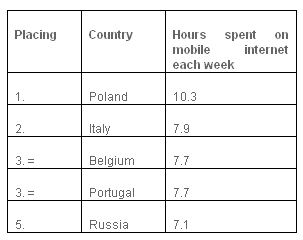
While these markets all display very different characteristics and are at varying stages of internet development, one trend that stands out is the speed of mobile internet growth. This is particularly apparent amongst the larger Eastern European countries, all of which show no signs of the time-lag observed in larger Western countries when dial-up internet and broadband connections were first adopted. Poland tops the chart of markets that spend the most time on mobile internet, with Russia also appearing in the top five. Interestingly, there are more mobile internet users in Turkey compared to those that access internet via their PC (21% vs. 20%) demonstrating that consumers will engage with new platforms if it makes the internet more accessible for their everyday lives.
These 'newer’ markets such as Russia, Turkey, Poland and Portugal are regarded as rising stars, with a rapid increase in weekly internet use expected in coming years. With an average growth in European internet use of 11% every 2 years, we can predict how internet penetration in these markets might grow in coming years - a useful indication for media planners as they as they increase the scope of their pan-European campaigns:
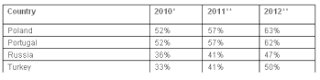
* Actual % internet use taken from EIAA Mediascope Europe 2010
** EIAA predictions (created using findings from Mediascope Europe 2004-2010 and externally sourced local market data)
Alison Fennah, Executive Director of the EIAA said: “Better devices and connectivity as well as enhanced consumer motivation all started coming together in 2009 to improve and extend the overall online experience. As a result, the internet is now being consumed across PC, laptop, mobile and gaming devices, providing 24-7 access to digital information and entertainment. This presents a compelling case for brands to explore and incorporate a growing number of complementary interactive platforms into the marketing mix.
“Indeed, new age patterns of media consumption indicate that marketers should be looking to develop multi-platform strategies that reach and connect with consumers more effectively and increase ROI. This is opposed to making media decisions based on an 'either or’ basis if they want to reach all demographics.”
Michael Kleindl, Chairman of the EIAA and Managing Partner of Valkiria Network said: “Technological innovation coupled with consumers’ continued desire to merge their media presents a huge opportunity for advertisers as we move into 2010. It is important for brands to adapt to this shift in internet mobility and use this insight to shape their marketing strategies.”
[1] The developing trend of 'word of mouth’ to 'word of web’ or communicating online
[2] This is an aggregate of: communicating via social networking sites and sending / receiving emails and instant messenger
Key European Findings
· Europeans are spending more time on 'internet-on-the-move’ (6.4 hours a week) compared to reading newspapers (4.8 hours) or magazines (4.1 hours)
· A rise in laptop ownership is driving greater media convergence – 36% of Europeans use the internet whilst watching TV
· There are now 121 million wireless broadband users in Europe allowing a greater mobility for internet users
· 71 million Europeans use the internet on their mobile each week – for an average of almost one hour every day
· Eastern European markets demonstrate opportunity for marketers to engage users via mobile internet
The European Interactive Advertising Association (EIAA) reveals the findings of new research that shows digital mobility making its way into the mainstream. Technological innovation coupled with a diverse range of access points for consumers is driving deeper usage online, presenting marketers with a vastly mobile pan-European audience to target and engage with in 2010 and beyond.
The EIAA’s Mediascope Europe study across 15 European markets highlights how consumers are extending the ways in which they enjoy and engage with the internet and its growing influence on everyday lives. With a majority of people now aware they can use the internet via their mobile phone (48% vs. 47%), and a growth in wireless broadband and laptop use, the findings demonstrate how the increased diversity of internet-enabled devices is allowing consumers to go online at any time of day and in more locations than ever before.
Increase in internet-on-the-move
Overall, 71 million Europeans browse the mobile internet in a typical week and, with almost an hour a day actively spent going online via their mobile (6.4 hours per week), 'internet-on-the-move’ is proving a more frequent pastime than reading newspapers (4.8 hours) or magazines (4.1 hours).
It is the younger generation of early adopters that is largely driving this increase with almost a quarter (24%) of 16-24 year olds and 21% of 25-34 year olds already using the mobile internet, spending 7.2 and 6.6 hours on it respectively each week. This trend of increased consumer reach and time spent online looks set to continue with improving internet coverage, speeds and services. Marketers would therefore be well advised to recognise how consumers are increasingly engaging with the internet, at more times throughout their day and across a myriad of interactive touch points, and ultimately use this insight to develop effective multi-media marketing strategies.
The internet as an entertainer and enabler
The internet continues to prove a popular source of entertainment with one quarter of Europeans (25%) gaming or listening to the radio online (25%), and one third watching films, TV or video clips online (32%) at least once a month. With over one quarter (29%) of Europeans following brands more as a result of the internet, the medium is being used for fun and for function signifying that users have high levels of both emotional and rational connection with the medium. Amongst those with an internet enabled phone, half (49%) claim to receive video clips, websites or images on their mobile and four in five (80%) say that they pass on the content they receive. This suggests that those online via their mobile are both technologically sophisticated and deeply engaged - highlighting a prime opportunity for marketers to build brand awareness and peer recommendations.
Additionally, 'Word of Web[1]’ continues to play a central role in communications with almost three quarters (71%) of European internet users admitting that they stay in touch with friends and relatives more as a result of the internet. Again, mobile seems to be a big driver with almost half (48%[2]) of Europeans using their internet enabled phones for more than verbal conversation. 16% state they communicate using social media via their mobile, with 16% also using mobile instant messenger. Advertisers can therefore benefit from the growing consumer appitite for constant updates and entertainment on the go and use this insight to plan for multi-media campaigns that engage with consumers across a number of platforms.
Converging media experiences
Media convergence is on the rise with the research revealing that one third (36%) of European use the internet whilst watching TV. With recent technological advancements such as the iPad, and given almost half (46%) of European households already own at least one laptop and 121 million Europeans (52%) now use wireless broadband, increased mobility and convergence seems inevitable. Marketers should no longer look at media in isolation but rather embrace the media-meshing trend and the wealth and diversity of advertising opportunity it affords.
Extending scope: changing the status quo
This year the Mediascope Europe study has been extended to incorporate a further five European markets in addition to the original ten. The research now includes Poland, Portugal, Russia, Switzerland and Turkey to capture the different ways in which consumer media habits and behaviours are developing across Europe.
While these markets all display very different characteristics and are at varying stages of internet development, one trend that stands out is the speed of mobile internet growth. This is particularly apparent amongst the larger Eastern European countries, all of which show no signs of the time-lag observed in larger Western countries when dial-up internet and broadband connections were first adopted. Poland tops the chart of markets that spend the most time on mobile internet, with Russia also appearing in the top five. Interestingly, there are more mobile internet users in Turkey compared to those that access internet via their PC (21% vs. 20%) demonstrating that consumers will engage with new platforms if it makes the internet more accessible for their everyday lives.

These 'newer’ markets such as Russia, Turkey, Poland and Portugal are regarded as rising stars, with a rapid increase in weekly internet use expected in coming years. With an average growth in European internet use of 11% every 2 years, we can predict how internet penetration in these markets might grow in coming years - a useful indication for media planners as they as they increase the scope of their pan-European campaigns:

* Actual % internet use taken from EIAA Mediascope Europe 2010
** EIAA predictions (created using findings from Mediascope Europe 2004-2010 and externally sourced local market data)
Alison Fennah, Executive Director of the EIAA said: “Better devices and connectivity as well as enhanced consumer motivation all started coming together in 2009 to improve and extend the overall online experience. As a result, the internet is now being consumed across PC, laptop, mobile and gaming devices, providing 24-7 access to digital information and entertainment. This presents a compelling case for brands to explore and incorporate a growing number of complementary interactive platforms into the marketing mix.
“Indeed, new age patterns of media consumption indicate that marketers should be looking to develop multi-platform strategies that reach and connect with consumers more effectively and increase ROI. This is opposed to making media decisions based on an 'either or’ basis if they want to reach all demographics.”
Michael Kleindl, Chairman of the EIAA and Managing Partner of Valkiria Network said: “Technological innovation coupled with consumers’ continued desire to merge their media presents a huge opportunity for advertisers as we move into 2010. It is important for brands to adapt to this shift in internet mobility and use this insight to shape their marketing strategies.”
[1] The developing trend of 'word of mouth’ to 'word of web’ or communicating online
[2] This is an aggregate of: communicating via social networking sites and sending / receiving emails and instant messenger
Friday, January 29, 2010
The Power of Marketing Friends in Social Media
If you knew five of my friends have tweeted or posted on Facebook rave reviews about their Audi, Q5, wouldn't you push that listing higher? Sure you would, but it's impossible to ask me questions about every topic I'm searching for. Of course, there is a better way to get to the same result, and it takes us back to the "Wisdom of Crowds" -- in this case, my crowd.
My friends and I happen to share similar geography and circumstances for the most part, which causes some amazing similarities. Moreover, I am much more likely to trust my friends' opinions than those of strangers. Anyone that's recently been on the search for a good doctor or dentist or accountant knows intimately how important it is to get recommendations from those you trust. This is "friendsourcing" -- the concept that people I know give better and more reliable answers for me than the world can as a whole.
To say this means we're on the edge of something big is a catastrophic understatement, but marketers have only started to scratch the surface of what this means for them and their clients. At very least, we've got three fundamental paradigm shifts to deal with:
1. What brands say and do in social media has an increasingly direct effect on how they will appear in search engines, both in search results position and in description.
2. The more friends in my social circle (aka my "social graph") talk about your brand, the more likely I am to see your brand, click on your brand's listing and become another voice talking about your brand.
3. Many brands have recognized that their impact in social media is both powerful and tangible, but now that impact will easily spill over into other channels. "Social" isn't just a silo in your channel mix anymore, and the lines will be increasingly blurred with mass media, CRM, SEO/SEM or other channels.
The good news is that it's never too late to stake a new claim in social media for your brand. So to get your team or your clients started, here are some quick first steps: Listen, record, observe and compare
There are a million tools on the market for searching or filtering social media conversations, and many of them are free -- Chris Brogan has an excellent list of the ones he uses here. Most organizations are doing this already, but it's usually in a vacuum from other marketing efforts. Instead of just looking through your "ego feeds" (conversations about your company), start checking on the conversations around your search engine marketing portfolio of keywords, or use Google's keyword tool to analyze your site and start your own list. It's often interesting to see the gap between what people say about you and what they say about your product or service -- this can lead to ideas for new content on your site or places for your social media team to try to change conversations. For extra credit, start comparing the trends on these terms to your offline media: are my mass communications moving this needle? Did my latest direct-mail piece with the killer offer spark some new conversation?
Start holding everyone responsible, but make someone accountable. Your organization's social "footprint" can't be managed as a hobby. Large or small, it's time to take this seriously, because the impact will be felt from cyberspace to the cash register. Almost all marketing units are affected by (and will probably have an opinion on) social media, so it's often good to start with some kind of a "task force" comprised of representatives from each. However, the business needs to make a decision of exactly which person will own its social presence. This person doesn't need to be the one running it day-to-day, but they need to be able to speak to it fluently and have the power to make a difference.
Create a social media "lodestone" within each of your marketing efforts. Even with a cross-functional team or steering committee, it's hard to keep the social media conversation from gravitating to just a couple of marketing functions. To be truly effective, each discipline needs to know how they intersect with social media, and needs to define that in a way that attracts and excites new projects. PR, for example, can own reaching out to specific voices and generating influential conversations. CRM, however, has the opportunity to focus on longer dialogues with individual customers.
My friends and I happen to share similar geography and circumstances for the most part, which causes some amazing similarities. Moreover, I am much more likely to trust my friends' opinions than those of strangers. Anyone that's recently been on the search for a good doctor or dentist or accountant knows intimately how important it is to get recommendations from those you trust. This is "friendsourcing" -- the concept that people I know give better and more reliable answers for me than the world can as a whole.
To say this means we're on the edge of something big is a catastrophic understatement, but marketers have only started to scratch the surface of what this means for them and their clients. At very least, we've got three fundamental paradigm shifts to deal with:
1. What brands say and do in social media has an increasingly direct effect on how they will appear in search engines, both in search results position and in description.
2. The more friends in my social circle (aka my "social graph") talk about your brand, the more likely I am to see your brand, click on your brand's listing and become another voice talking about your brand.
3. Many brands have recognized that their impact in social media is both powerful and tangible, but now that impact will easily spill over into other channels. "Social" isn't just a silo in your channel mix anymore, and the lines will be increasingly blurred with mass media, CRM, SEO/SEM or other channels.
The good news is that it's never too late to stake a new claim in social media for your brand. So to get your team or your clients started, here are some quick first steps: Listen, record, observe and compare
There are a million tools on the market for searching or filtering social media conversations, and many of them are free -- Chris Brogan has an excellent list of the ones he uses here. Most organizations are doing this already, but it's usually in a vacuum from other marketing efforts. Instead of just looking through your "ego feeds" (conversations about your company), start checking on the conversations around your search engine marketing portfolio of keywords, or use Google's keyword tool to analyze your site and start your own list. It's often interesting to see the gap between what people say about you and what they say about your product or service -- this can lead to ideas for new content on your site or places for your social media team to try to change conversations. For extra credit, start comparing the trends on these terms to your offline media: are my mass communications moving this needle? Did my latest direct-mail piece with the killer offer spark some new conversation?
Start holding everyone responsible, but make someone accountable. Your organization's social "footprint" can't be managed as a hobby. Large or small, it's time to take this seriously, because the impact will be felt from cyberspace to the cash register. Almost all marketing units are affected by (and will probably have an opinion on) social media, so it's often good to start with some kind of a "task force" comprised of representatives from each. However, the business needs to make a decision of exactly which person will own its social presence. This person doesn't need to be the one running it day-to-day, but they need to be able to speak to it fluently and have the power to make a difference.
Create a social media "lodestone" within each of your marketing efforts. Even with a cross-functional team or steering committee, it's hard to keep the social media conversation from gravitating to just a couple of marketing functions. To be truly effective, each discipline needs to know how they intersect with social media, and needs to define that in a way that attracts and excites new projects. PR, for example, can own reaching out to specific voices and generating influential conversations. CRM, however, has the opportunity to focus on longer dialogues with individual customers.
Tuesday, January 19, 2010
Online Newspaper Advertising - Latin America
Online newspapers are the essential link for people to stay connected to information, news and their home countries.
When they read the news directly from online newspapers such as La Prensa from Panama or La Republica from Costa Rica, they are receiving un-biased news and information directly from their country. Readers review their local news covering subjects from politics to the latest gossip from their countries' entertainment. Now the technological enhancements of the internet makes reading online newspapers easier than ever!
I stumbled upon an article by Mort Goldstrom about the reasons why to advertise in online newspapers. I think this very much applies to Latin America and reinforces why it is so important for advertisers to include this in their online marketing mix. I hope sharing this with you increases your knowledge and helps you understand more in depth how the online newspaper opportunities can really work for your clients.
10 Reasons to Advertise on a Newspaper Website
Frequency- The online newspaper Web site user spends more than twice as many hours online than the general user. Online newspaper users are three times as likely as general 'Net users to be online during the workday when out of reach of other media - 8-11 a.m. is a new "primetime" for media consumption (Source: "Power Users," 2006, MORI Research)
Credibility- Branded content brings a higher quality audience. A study from the Online Publishers Association (OPA) showed that OPA audiences were more likely to buy products and services in a number of key categories, including automotive, entertainment, financial, home, travel and business to business.
Targeted- If you want to focus on a particular backyard, advertising in an online newspaper is more personal and more relevant because it is local. Newspapers also publish a plethora of niche sites (youth, women, movie fans, Hispanics, are illustrative) for virtually any demographic advertisers could possibly hope to reach. - "Newspapers know more than ever about their web audience because of online registration programs and audience segmentation software"]
Purchasing Power- Eighty-nine percent of newspaper Web site users purchase online compared with 56 percent of general users. Forty percent of online newspaper users have incomes higher than $75,000; 69 percent own their homes. Eighteen percent of online newspaper users have spent more than $2,000 online in the last six months.
Content- Excluding e-mail the most popular online activities and content categories include national and local news, sports, financial information and entertainment news and things to do. [Shopping, cited in the original, is lower on the list.] Fifty-four percent of general Internet users visit online newspapers for local news, compared with 40 percent for the local TV station Web site and 20 percent for the local radio station site. ["Power Users," 2006, MORI Research]
Advertisers Believe in Newspaper Sites- Online newspapers have enjoyed eleven consecutive quarters of double digit increases for advertising since NAA started reporting online ad spending in 2004.
High Profile- Online newspapers generate very large gains in Online Ad Awareness among C-level and other higher management job holders: C-level managers showed a 23 percent increase in Aided Brand Awareness, VP/director-level managers showed a 38 percent increase and other management showed a 37 percent increase following their exposure to an ad campaign in online newspapers (across all industries.) When the brand metric shifts to Message Association, C-level execs showed the largest increase in lift after exposure to campaigns on online newspapers, at 88 percent. No management category showed less than a 51 percent increase. (Dynamic Logic's MarketNorms database, 2006)
Reinforcement- Fifty-six percent of online newspaper users also read the newspaper in the past five days, and repetition increases awareness.
Cutting Edge- Newspaper Web site users are more likely (by almost twenty percent to own some kind of portable electronic device. They are also more interested in receiving advertising and product offers through those devices. Forty percent of online newspaper users are aged 18 to 34. [Source: "Power Users," 2006, MORI Research]
Mix- A variety of recent studies have demonstrated the power of online, when included in a mix with traditional media, to elaborate the brand message. Newspaper, print, and online products combined have the highest penetration and most desirable audience of any other local medium.
When they read the news directly from online newspapers such as La Prensa from Panama or La Republica from Costa Rica, they are receiving un-biased news and information directly from their country. Readers review their local news covering subjects from politics to the latest gossip from their countries' entertainment. Now the technological enhancements of the internet makes reading online newspapers easier than ever!
I stumbled upon an article by Mort Goldstrom about the reasons why to advertise in online newspapers. I think this very much applies to Latin America and reinforces why it is so important for advertisers to include this in their online marketing mix. I hope sharing this with you increases your knowledge and helps you understand more in depth how the online newspaper opportunities can really work for your clients.
10 Reasons to Advertise on a Newspaper Website
Frequency- The online newspaper Web site user spends more than twice as many hours online than the general user. Online newspaper users are three times as likely as general 'Net users to be online during the workday when out of reach of other media - 8-11 a.m. is a new "primetime" for media consumption (Source: "Power Users," 2006, MORI Research)
Credibility- Branded content brings a higher quality audience. A study from the Online Publishers Association (OPA) showed that OPA audiences were more likely to buy products and services in a number of key categories, including automotive, entertainment, financial, home, travel and business to business.
Targeted- If you want to focus on a particular backyard, advertising in an online newspaper is more personal and more relevant because it is local. Newspapers also publish a plethora of niche sites (youth, women, movie fans, Hispanics, are illustrative) for virtually any demographic advertisers could possibly hope to reach. - "Newspapers know more than ever about their web audience because of online registration programs and audience segmentation software"]
Purchasing Power- Eighty-nine percent of newspaper Web site users purchase online compared with 56 percent of general users. Forty percent of online newspaper users have incomes higher than $75,000; 69 percent own their homes. Eighteen percent of online newspaper users have spent more than $2,000 online in the last six months.
Content- Excluding e-mail the most popular online activities and content categories include national and local news, sports, financial information and entertainment news and things to do. [Shopping, cited in the original, is lower on the list.] Fifty-four percent of general Internet users visit online newspapers for local news, compared with 40 percent for the local TV station Web site and 20 percent for the local radio station site. ["Power Users," 2006, MORI Research]
Advertisers Believe in Newspaper Sites- Online newspapers have enjoyed eleven consecutive quarters of double digit increases for advertising since NAA started reporting online ad spending in 2004.
High Profile- Online newspapers generate very large gains in Online Ad Awareness among C-level and other higher management job holders: C-level managers showed a 23 percent increase in Aided Brand Awareness, VP/director-level managers showed a 38 percent increase and other management showed a 37 percent increase following their exposure to an ad campaign in online newspapers (across all industries.) When the brand metric shifts to Message Association, C-level execs showed the largest increase in lift after exposure to campaigns on online newspapers, at 88 percent. No management category showed less than a 51 percent increase. (Dynamic Logic's MarketNorms database, 2006)
Reinforcement- Fifty-six percent of online newspaper users also read the newspaper in the past five days, and repetition increases awareness.
Cutting Edge- Newspaper Web site users are more likely (by almost twenty percent to own some kind of portable electronic device. They are also more interested in receiving advertising and product offers through those devices. Forty percent of online newspaper users are aged 18 to 34. [Source: "Power Users," 2006, MORI Research]
Mix- A variety of recent studies have demonstrated the power of online, when included in a mix with traditional media, to elaborate the brand message. Newspaper, print, and online products combined have the highest penetration and most desirable audience of any other local medium.
Thursday, January 14, 2010
Time Management in Marketing & PR
“I need more time”. “There just aren’t enough hours in the day to get this done”. “I’ll be burning the midnight oil”. How many times have you heard any of these from a co-worker or said them yourself? Marketing and PR projects can be just as much of a time crunch as in any other industry. With that said, it’s important for clients to understand project timelines/deadlines so the work can be completed on time and efficiently.
1. Make a plan
You have a project, now make a plan as to how it will be implemented. Who will be working on the project? What information is needed to get it done? When is it due? Who is in charge of putting the project together for delivery?
2. Implementation
Now that you have your plan together, with tasks assigned, it’s time to implement. Have regular meetings with team members to make sure everyone is on track and there are no problems. Handle any problems that arise immediately. If someone is unable to obtain a key piece of information, brainstorm, reach out to others, if necessary.
When working on the project timelines, build in time for reviewing and making changes to the project (brochures, scripts, ads, etc).
3. Delivery
When delivering the project, have someone with fresh eyes review the project. Make changes where necessary to ensure a valuable product is delivered.
4. Thank the team
Don’t forget to always thank your team members for their important contributions. If something went awry, consider it a learning experience and don’t make the same mistake next time.
5. Review
Review what went right and wrong on the project. Take team members’ input seriously. If necessary, do a case study and distribute it throughout the company. Everyone will appreciate knowing how to do things more efficiently.
These are just some of the things that can be done to ensure your project stays on task and on time. Any other suggestions?
1. Make a plan
You have a project, now make a plan as to how it will be implemented. Who will be working on the project? What information is needed to get it done? When is it due? Who is in charge of putting the project together for delivery?
2. Implementation
Now that you have your plan together, with tasks assigned, it’s time to implement. Have regular meetings with team members to make sure everyone is on track and there are no problems. Handle any problems that arise immediately. If someone is unable to obtain a key piece of information, brainstorm, reach out to others, if necessary.
When working on the project timelines, build in time for reviewing and making changes to the project (brochures, scripts, ads, etc).
3. Delivery
When delivering the project, have someone with fresh eyes review the project. Make changes where necessary to ensure a valuable product is delivered.
4. Thank the team
Don’t forget to always thank your team members for their important contributions. If something went awry, consider it a learning experience and don’t make the same mistake next time.
5. Review
Review what went right and wrong on the project. Take team members’ input seriously. If necessary, do a case study and distribute it throughout the company. Everyone will appreciate knowing how to do things more efficiently.
These are just some of the things that can be done to ensure your project stays on task and on time. Any other suggestions?
Friday, September 25, 2009
Hiring a Digital Agency
Hiring (and firing) an agency goes with the territory for brand marketers. But what was once a multi-year (or longer) relationship between the brand client and their agency has become much more fluid. Whether you're talking about bringing in a new agency of record or adding another player to your agency mix, brand-side clients are always evaluating agency talent, and the fast pace of digital means that brands will likely have to sign on the dotted line with greater frequency.
There are a number of places to start when hiring a new agency, start by asking, "Why do we need a new agency?" Maybe you've inherited them and you just can't work together -- you've tried, but it's a chemistry thing.
Why do we need a new agency? -- will always lead to some rather profound insights, if the brand can be honest about its own corporate culture as well as what's gone right (and wrong) with the relationship at hand. While that may sound like simple advice, it's a pill not easily swallowed by many clients.
Broadly speaking, ask yourself if your company culture supports the changes the agency is trying to make? Examine your relationship to see if it allows for shared risk. Is the agency forced to stay inside a box or are they given some freedom?
Those answers may not always be available because in some cases, the relationship may have become so bad that it's nearly impossible to see the forest through the trees. Take the time to reflect on your own corporate culture and how it interplayed with their previous agency stand a much better chance of getting it right with their next hire.
Beware of the specialist search
Scan the tech blogs and you'll quickly see that digital creates new communication channels faster than advertisers can figure out how to use them. But CMOs who want to integrate their media strategy face a difficult dilemma: Do you opt for a "specialist" agency -- a social media shop, for example -- to work in a highly technical area, or do you hire one agency that can bring it all together at the risk of sacrificing some key knowledge in an emerging area?
The answer depends more on your own organization's strength and weaknesses than anything else. It's all about orchestration, if you have the time and staff to orchestrate across multiple specialists, then you have the option to spread the love. If you're like most organizations, however, and you're short-staffed and time-crunched, then you should find and assign a lead agency and have them sub-contract for the specialists.
If you have a lead agency responsible for bringing holistic thinking, then they will have the responsibility to be constantly searching for specialists and providing you with thought leadership and success.
Restless can be a winner
No matter how exhaustive your hiring process is, you will always face the same problem: All agencies look great before you hire them.
They always put their best foot forward when you're looking at a new agency. A lot of times you're looking at their work, and maybe it wasn't all their original idea, but they executed on it. Or maybe they had the big idea, but some other agency put it in action -- no agency is ever going to tell you exactly what they did. So, there's always some mystery there.
It's not about what the agency did to get in the room with him -- that's all prelude. In a nutshell, he says, he's always on the lookout for a "restless" agency. It's really about doing great work, but having that mindset to say, okay we hit all of our goals, but how could we have done it better? That's the kind of restlessness you want from your agency.
Find an agency that experiment
It is important that the agency is adding expertise. There's always something new, something that's experimental, and it is important that the agency is keeping up with the times. That's critical, and experimentation is a sign of a good agency.
Look for existing partnerships
For better or worse, most brands use a mix of agencies these days. But whether those agencies work together or fight each other tooth and nail for a larger share of the client's business often depends on two factors.
First, it's up to the client to set the tone for cooperation, and while some brands prefer in-fighting among their agencies, most at least say that they want team work.
My experience on both the client and agency sides shows that regardless of whether the agencies work together; there will always be a level of competition going on.
You need to communicate the ground rules before, during, and after the contracts are signed -- what the rules of engagement will be. If you don't want to see or hear the campaigning, then you need to let them know that and chastise their senior management when they do.
But ground rules will only take you so far, and if you haven't hired an agency that knows how to play well with others, you're going to be in for bumpy ride, which means that even before you set the ground rules, you have to seek out the right kind of agency partner.
If a firm already has existing strategic partnerships, this bodes well for them being willing to share the sandbox with others. A smart agency realizes they can't be the best in every area, and a focused agency will usually want to work on that which they know they can produce superior results.
Chemistry counts, but chemists aren't needed
Nearly all great teams have some level of chemistry. But whether you're talking about the chemistry between your staff and your agency, or the relationship between your various agencies, it is possible to go overboard. And in fact, some CMOs tend to focus too much on chemistry.
Chemistry is probably [the] No. 1 [thing a CMO should look for in an agency. You've got to be able to work together. But don't let a personality glitch blind you to the attributes of an agency if you'll never have to work with that person.
There are a number of places to start when hiring a new agency, start by asking, "Why do we need a new agency?" Maybe you've inherited them and you just can't work together -- you've tried, but it's a chemistry thing.
Why do we need a new agency? -- will always lead to some rather profound insights, if the brand can be honest about its own corporate culture as well as what's gone right (and wrong) with the relationship at hand. While that may sound like simple advice, it's a pill not easily swallowed by many clients.
Broadly speaking, ask yourself if your company culture supports the changes the agency is trying to make? Examine your relationship to see if it allows for shared risk. Is the agency forced to stay inside a box or are they given some freedom?
Those answers may not always be available because in some cases, the relationship may have become so bad that it's nearly impossible to see the forest through the trees. Take the time to reflect on your own corporate culture and how it interplayed with their previous agency stand a much better chance of getting it right with their next hire.
Beware of the specialist search
Scan the tech blogs and you'll quickly see that digital creates new communication channels faster than advertisers can figure out how to use them. But CMOs who want to integrate their media strategy face a difficult dilemma: Do you opt for a "specialist" agency -- a social media shop, for example -- to work in a highly technical area, or do you hire one agency that can bring it all together at the risk of sacrificing some key knowledge in an emerging area?
The answer depends more on your own organization's strength and weaknesses than anything else. It's all about orchestration, if you have the time and staff to orchestrate across multiple specialists, then you have the option to spread the love. If you're like most organizations, however, and you're short-staffed and time-crunched, then you should find and assign a lead agency and have them sub-contract for the specialists.
If you have a lead agency responsible for bringing holistic thinking, then they will have the responsibility to be constantly searching for specialists and providing you with thought leadership and success.
Restless can be a winner
No matter how exhaustive your hiring process is, you will always face the same problem: All agencies look great before you hire them.
They always put their best foot forward when you're looking at a new agency. A lot of times you're looking at their work, and maybe it wasn't all their original idea, but they executed on it. Or maybe they had the big idea, but some other agency put it in action -- no agency is ever going to tell you exactly what they did. So, there's always some mystery there.
It's not about what the agency did to get in the room with him -- that's all prelude. In a nutshell, he says, he's always on the lookout for a "restless" agency. It's really about doing great work, but having that mindset to say, okay we hit all of our goals, but how could we have done it better? That's the kind of restlessness you want from your agency.
Find an agency that experiment
It is important that the agency is adding expertise. There's always something new, something that's experimental, and it is important that the agency is keeping up with the times. That's critical, and experimentation is a sign of a good agency.
Look for existing partnerships
For better or worse, most brands use a mix of agencies these days. But whether those agencies work together or fight each other tooth and nail for a larger share of the client's business often depends on two factors.
First, it's up to the client to set the tone for cooperation, and while some brands prefer in-fighting among their agencies, most at least say that they want team work.
My experience on both the client and agency sides shows that regardless of whether the agencies work together; there will always be a level of competition going on.
You need to communicate the ground rules before, during, and after the contracts are signed -- what the rules of engagement will be. If you don't want to see or hear the campaigning, then you need to let them know that and chastise their senior management when they do.
But ground rules will only take you so far, and if you haven't hired an agency that knows how to play well with others, you're going to be in for bumpy ride, which means that even before you set the ground rules, you have to seek out the right kind of agency partner.
If a firm already has existing strategic partnerships, this bodes well for them being willing to share the sandbox with others. A smart agency realizes they can't be the best in every area, and a focused agency will usually want to work on that which they know they can produce superior results.
Chemistry counts, but chemists aren't needed
Nearly all great teams have some level of chemistry. But whether you're talking about the chemistry between your staff and your agency, or the relationship between your various agencies, it is possible to go overboard. And in fact, some CMOs tend to focus too much on chemistry.
Chemistry is probably [the] No. 1 [thing a CMO should look for in an agency. You've got to be able to work together. But don't let a personality glitch blind you to the attributes of an agency if you'll never have to work with that person.
Wednesday, September 16, 2009
When Agencies Should Defend In a Review
Understand the average: Your agency has a 95% chance of losing a review.
When to participate?
• Mandated reviews (e.g. government contracts; rules set by procurement or purchasing departments).
• Roster reviews.
• Agency consolidation reviews.
• When you have very strong, deep relationships and the results to back them up (and there's been no change in management).
When not to participate?
• When there are serious concerns (from either side) about the agency relationship or business performance.
• Management changes, particularly when you know that the incoming leadership has successfully worked with other agencies.
• Announcement of an unscheduled review.
• Announcement of a non-roster review.
Like the emotion of wanting to get even, defend yourself, or inflict equivalent harm that you might feel when thinking about sueing someone, it's easy to get caught up in the emotion of wanting to fight and "spend whatever it takes" to keep your hard-won or long-tenured client. However, the smart new business decision may well be to spend the money winning a new piece of business.
When to participate?
• Mandated reviews (e.g. government contracts; rules set by procurement or purchasing departments).
• Roster reviews.
• Agency consolidation reviews.
• When you have very strong, deep relationships and the results to back them up (and there's been no change in management).
When not to participate?
• When there are serious concerns (from either side) about the agency relationship or business performance.
• Management changes, particularly when you know that the incoming leadership has successfully worked with other agencies.
• Announcement of an unscheduled review.
• Announcement of a non-roster review.
Like the emotion of wanting to get even, defend yourself, or inflict equivalent harm that you might feel when thinking about sueing someone, it's easy to get caught up in the emotion of wanting to fight and "spend whatever it takes" to keep your hard-won or long-tenured client. However, the smart new business decision may well be to spend the money winning a new piece of business.
Friday, September 11, 2009
Optimizing Your Facebook Initiatives
Traditional search marketing holds that there are two ways to get search engine traffic. The first is to pay for it via pay-per-click advertising, and the second is to earn the traffic with optimal search engine placement. In the earned search marketing business of search engine optimization (SEO), a Facebook fan page is merely a web page, just like any other, except that it has the built-in benefit of residing on a very powerful domain. The same goes for YouTube, Twitter, and LinkedIn. Smart optimization, combined with the strong domains that house them, can propel your social media pages to the top of search engine results for relevant searches.
With that in mind, here are tips for optimizing your Facebook initiatives, as well as some brands that are getting it right.
Facebook
Quick tips for optimization:
Provide regular updates. Like most social media, a Facebook page is only as good as the content available for fans to interact with. Generally speaking, the more digital assets (videos, photos, etc.) the better. Provide regular updates (at least daily and preferably more, though this will depend on your niche) that encourage user participation. Respond to user feedback. To keep from falling behind, consider creating a calendar of updates at the beginning of each week or month.
Choose a good name for the page. The name of your Facebook page is arguably the most important early decision you will make because this is the very first thing the search engines will see when they visit your page. At the very least, you should include the name of the business. You might also include targeted keywords if appropriate.
Choose a good username. A username allows you to have a "clean" URL. For example, if you choose "dwaynejohnsonrocks" as your username, your page URL will be "www.facebook.com/dwaynejohnsonrocks." These URLs look nicer on business cards and letterhead, and they are easier to remember.
Vanity URLs, as they are called, also provide an opportunity for further optimization with your business name or a selected keyword. Given the choice between the two, the business name will be more appropriate in most cases.
Take advantage of the "about" box. The "about" box is a great place to include relevant content and keyword-rich descriptions. This is one of the only places on a page's "wall" that allows for fully customized copy to be written. Many pages use this space to simply provide a link back to the corporate website or place their tagline, but it is an ideal place to help the search engines understand more about your page.
Customize your page. Facebook allows for a moderate amount of customization. You can't change backgrounds or otherwise skin the page, but you can completely customize other things. For example, you have a large degree of control over how your tabs appear. In addition to adding unique content inside "boxes," you can frame a page hosted elsewhere, which allows for full control over the look and feel of that particular tab (within the confines of the Facebook page that surrounds it, of course).
A customized page immediately communicates credibility to the user and also shows a commitment to your brand's involvement with not only Facebook but also social media as a whole.
Who did it great
Threadless
The online T-shirt company Threadless has been active in social media since its inception. Its business model of printing user-submitted and user-voted designs requires an environment that encourages feedback and user interaction.
With that in mind, here are tips for optimizing your Facebook initiatives, as well as some brands that are getting it right.
Quick tips for optimization:
Provide regular updates. Like most social media, a Facebook page is only as good as the content available for fans to interact with. Generally speaking, the more digital assets (videos, photos, etc.) the better. Provide regular updates (at least daily and preferably more, though this will depend on your niche) that encourage user participation. Respond to user feedback. To keep from falling behind, consider creating a calendar of updates at the beginning of each week or month.
Choose a good name for the page. The name of your Facebook page is arguably the most important early decision you will make because this is the very first thing the search engines will see when they visit your page. At the very least, you should include the name of the business. You might also include targeted keywords if appropriate.
Choose a good username. A username allows you to have a "clean" URL. For example, if you choose "dwaynejohnsonrocks" as your username, your page URL will be "www.facebook.com/dwaynejohnsonrocks." These URLs look nicer on business cards and letterhead, and they are easier to remember.
Vanity URLs, as they are called, also provide an opportunity for further optimization with your business name or a selected keyword. Given the choice between the two, the business name will be more appropriate in most cases.
Take advantage of the "about" box. The "about" box is a great place to include relevant content and keyword-rich descriptions. This is one of the only places on a page's "wall" that allows for fully customized copy to be written. Many pages use this space to simply provide a link back to the corporate website or place their tagline, but it is an ideal place to help the search engines understand more about your page.
Customize your page. Facebook allows for a moderate amount of customization. You can't change backgrounds or otherwise skin the page, but you can completely customize other things. For example, you have a large degree of control over how your tabs appear. In addition to adding unique content inside "boxes," you can frame a page hosted elsewhere, which allows for full control over the look and feel of that particular tab (within the confines of the Facebook page that surrounds it, of course).
A customized page immediately communicates credibility to the user and also shows a commitment to your brand's involvement with not only Facebook but also social media as a whole.
Who did it great
Threadless
The online T-shirt company Threadless has been active in social media since its inception. Its business model of printing user-submitted and user-voted designs requires an environment that encourages feedback and user interaction.
Wednesday, August 26, 2009
The Importance of an “Agency of Record"
If getting the most of your agencies means harnessing the power of collaboration to bring about an environment where the big idea can come from anyone, it would seem that a brand has two clear choices. On the one hand, it can use one agency (perhaps calling it an agency of record) to lead all other agencies. On the other hand, the brand can choose to forgo the agency of record and instead manage its agency teams directly.
While either approach may lead to a collaborative environment (since the dawn of digital, agencies have come a long way toward working together) brands that opt to go without an agency of record run the risk of forfeiting the strength of a knowledgeable partner capable of thinking about the client's strategic interests.
The concept of an agency of record remains vitally important for major advertisers and marketers, agencies of record provide continuity, stability, and efficiencies that one-off, ad hoc, or project partners simply can't meet.
The notion of an agency of record that drives the strategy and the brand is more vital now than ever. But traditional agency revenue models where money is made on production and media commission is waning. And that means that someone ultimately must take responsibility for the brand's strategic vision.
A brand also needs people on the inside who understand what marketing is and how it works, and who live, eat, and sleep your brand. These are the nuts-and-bolts people who will move your business forward. They're the CMOs of tomorrow, but today they're trying to prove themselves and (hopefully) trying to learn as much as they can about marketing.
While either approach may lead to a collaborative environment (since the dawn of digital, agencies have come a long way toward working together) brands that opt to go without an agency of record run the risk of forfeiting the strength of a knowledgeable partner capable of thinking about the client's strategic interests.
The concept of an agency of record remains vitally important for major advertisers and marketers, agencies of record provide continuity, stability, and efficiencies that one-off, ad hoc, or project partners simply can't meet.
The notion of an agency of record that drives the strategy and the brand is more vital now than ever. But traditional agency revenue models where money is made on production and media commission is waning. And that means that someone ultimately must take responsibility for the brand's strategic vision.
A brand also needs people on the inside who understand what marketing is and how it works, and who live, eat, and sleep your brand. These are the nuts-and-bolts people who will move your business forward. They're the CMOs of tomorrow, but today they're trying to prove themselves and (hopefully) trying to learn as much as they can about marketing.
Subscribe to:
Posts (Atom)